
What We Are Really Carrying Into November
Oct 29, 2026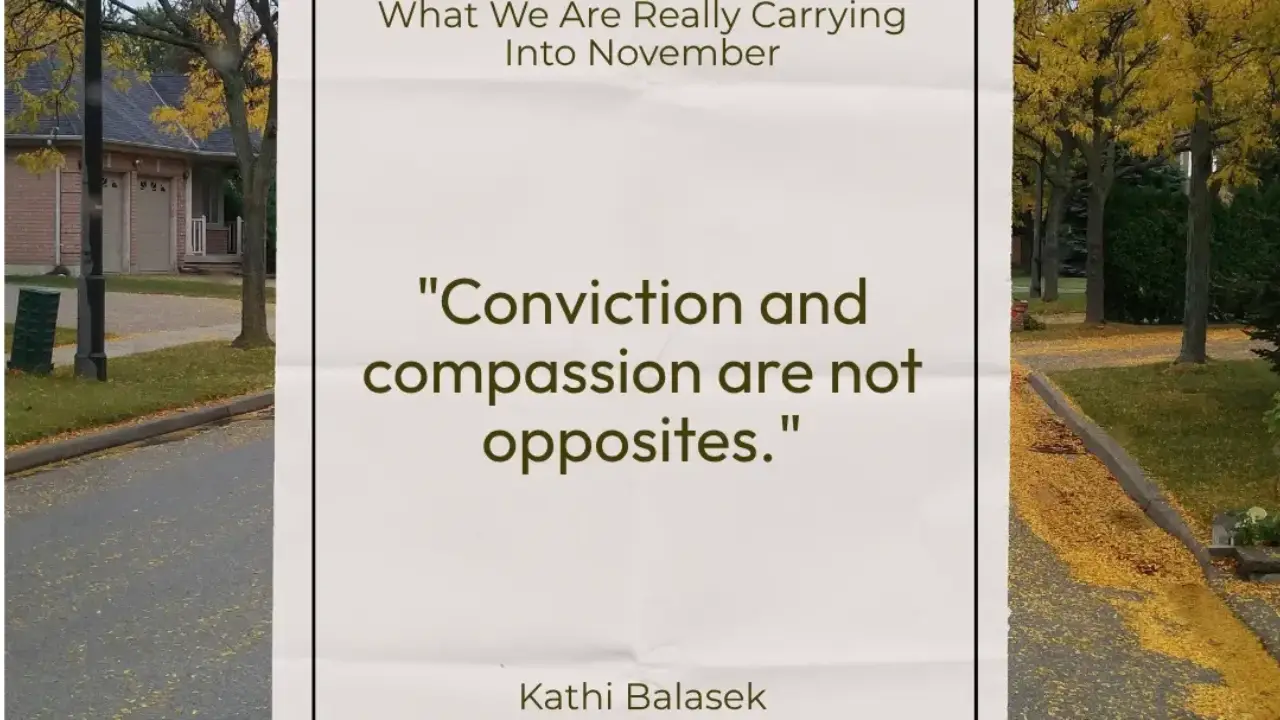
In the days before the midterms, many of us are carrying something we do not have a name for.
It shows up at the kitchen table. In a client meeting. In the family group text that suddenly goes quiet. Someone says, “I don’t even recognize this country anymore,” and the room tenses, because we assume the next sentence will be about a party.
But most of the time, it isn’t. Most of the time, it is about loss.
This is not only politics. It is loss.
Underneath the yard signs and the headlines, people on every side are saying a version of the same thing: I am afraid of losing something I love.
The research backs this up. In the American Psychological Association’s Stress in America 2024 survey, 80% of Republicans, 79% of Democrats, and 73% of independents named the future of the nation as a significant source of stress. That is not a divided feeling. That is one heavy feeling, shared, arriving from different directions.
So here is the reframe I want to offer. When we treat these feelings only as political opinions, we argue with them. When we recognize them as grief, we can sit with them. And sitting with someone is where trust begins.
What collective grief is
Collective grief is the loss we feel together, even when nothing has happened to us personally. No one died. No one got a diagnosis. And yet something feels gone.
It is the grief of a community, a generation, or a country. We felt it during the pandemic. We feel it after a public tragedy. And we feel it, more quietly, when the ground seems to shift under the place we call home.
Collective grief is often grief that goes unrecognized. No one gets time off for “I’m worried about my country.” No one drops off a casserole. So the feeling goes looking for somewhere to land, and too often it lands as anger at each other.
Anticipatory loss: grieving a future that has not arrived
Anticipatory loss is the grief we feel before a loss happens. Caregivers know it well. You begin missing someone while they are still here.
Elections can stir up a version of it. We picture a future for ourselves, our children, and our grandchildren, and then we fear it slipping away. We grieve:
- the country we believe we grew up in
- the opportunities we want our kids to have
- the sense that the rules are fair and steady
- the retirement, the town, or the community we imagined
Here is the part that surprises people. Two neighbors can be grieving the same future and voting in opposite directions to protect it. The yearning is shared. The path is where we differ.
I want to be honest with you. I hold my political convictions deeply, and I’m not asking you to set yours aside. Conviction and compassion are not opposites. I can believe strongly in the path I’m choosing and still recognize the grief in someone choosing a different one. Recognizing someone’s loss is not the same as agreeing with their vote. It simply means I see the person before I see the ballot.
The losses we share
When people talk about the state of the world, they are often naming secondary losses: the losses underneath the headline. These belong to all of us.
- Certainty: “I don’t know what’s going to happen.”
- Safety: “Is my community still safe?”
- Stability: “Everything feels unstable right now.”
- Trust: “I don’t know who to believe anymore.”
- Belonging: “I don’t recognize this country anymore.”
- Hope for the next generation: “What kind of world will my grandkids inherit?”
Read those sentences again and try to guess who said them. You can’t. That is the point.
What to say, and what not to say
Whether you are a leader, an advisor, a parent, or a friend, your role is not to win the conversation. It is to acknowledge what the other person is carrying. A simple pattern to hold onto:
- Acknowledge the feeling. “You are not alone in feeling that uncertainty right now.”
- Normalize the concern. “It makes sense that it would show up when you think about the future.”
- Refocus on what matters to them. “What part of this feels heaviest for you and your family?”
- Keep the conversation open. “What else has been on your mind?”
And a few well-meaning phrases that quietly dismiss what someone is carrying: “Don’t worry about it.” “It always swings back.” “That’s just the news cycle.”
If you remember only one sentence, let it be this one: “I hear what you’re carrying.”
A toolkit for the hard conversations
At the family table
“I know we see this differently. I also know we both want good things for the kids. Can we start there?” “You sound worried. What are you most afraid of losing?”
At work, for leaders
“This week may feel heavy for some of you, no matter how you vote. If you need a little grace on a deadline, just tell me.” “Our team includes people who see this differently. What we share is respect for each other.”
In client conversations, for advisors
“When the world feels unpredictable, it’s natural to wonder how it affects your future. Would it help to look at the parts we can plan for together?” “Whatever happens, your plan was built around what matters to you. Let’s make sure it still reflects that.”
With a friend who is struggling
“I’m not going to try to talk you out of how you feel. I just want you to know you’re not alone in it.” “Do you want to talk about it, or would a break from it help tonight?”
One feeling, many ballots
We mark different boxes. But many of us carry the same thing into the voting booth: love for the people we want to protect, and fear of losing a future we can already picture.
Grief is a universal experience, not a universal language. This is the week we get to practice the language.
Grief literacy is a skill any leader can learn. Kathi helps leaders, teams, and financial professionals find the words for life’s hardest moments—across every kind of loss and every kind of divide. Download the free Grief-Ready Advisor Field Guide, or book a conversation with Kathi.
